Updated: December 18th, 2025
Overview
The National Health Interview Survey (NHIS) is a nationwide program that collects and analyzes data on a wide range of health topics. It holds the distinction of being the nation’s oldest and longest continuously running health survey, dating back to 1957 following the signing of the National Health Survey Act by President Eisenhower in 1956. NHIS gathers accurate and up-to-date statistical information on illness, disability, and healthcare utilization in the United States, providing nationally representative data on health trends among the civilian noninstitutionalized population across diverse demographic and socioeconomic characteristics 1,2.
NHIS is conducted by the National Center for Health Statistics (NCHS), with interviews administered by trained U.S. Census Bureau field staff. The survey uses a stratified probability design that continuously samples the civilian noninstitutionalized U.S. population through weekly household interviews, oversampling underrepresented groups to ensure nationally representative results 3. The survey is cross-sectional, collecting data from different individuals in one-year cycles rather than following participants over time. In 1985, NHIS transitioned from using the Current Population Survey sampling frame to an independent approach, with routine census updates that improve sampling efficiency 4. While the previous design was multistage, the current design no longer employs this method 2,5.
Each year, approximately 27,000 adults and 9,000 children participate in confidential, face-to-face interviews. While questionnaires are constructed for continuity, survey content is updated every 15–20 years to reflect methodological advances and evolving health topics, with annual question changes addressing current needs 2,6. NCHS regularly adds questions on emerging topics, such as opioid use and pain management (2019) or concussions (2020-2021). To provide more robust datasets for analyzing complex relationships, NHIS data has been linked with data from other sources, with these linked datasets available in the RDC 7,8.
Researchers combining cross-sectional iterations for longitudinal analysis should review recommendations in the NHIS Questionnaires, Datasets, and Documentation and monitor questionnaire redesign notices like the 2019 NHIS Questionnaire Redesign 3,8,9.
The types of data collected include 5,7,8:
Demographic Data: Basic demographics such as age, gender, race, socioeconomic status, family characteristics, and geographic location information such as state and urbanicity.
Disability and Health Limitations: Measures of restricted-activity days, bed-disability days, work- and school-loss days, bed days over the last 12 months, and long-term limitations from chronic diseases or impairments.
Healthcare Utilization: Information on physician visits (during a 2-week period, interval since the last visit, and number of visits in the last 12 months), short-stay hospitalizations (number of episodes and days per stay), health insurance coverage, dental health, and medical device implants for all family members.
Chronic and Acute Conditions: Data on conditions responsible for disability days and physician visits, diabetes (initial and follow-up screenings and risk factors), orofacial pain, digestive disorders, and selected chronic conditions. Additionally, cancer risk factors are assessed through both control and epidemiology samples, and information on poliomyelitis is gathered.
Occupational and Lifestyle Data: Longest job worked, measures of occupational health, and information on smoking and alcohol use for adults 18 years and over.
Family and Individual Health Data: Child health data for one child per family under 18 years, and information on child adoption for female family members 20-54 years old.
Rotating Core Questions: Regularly scheduled but not annual questions on topics including mental health (psychological distress), use of health services (preventive services), health-related behaviors (physical activity and sleep), injuries and chronic pain, and allergies.
Sponsored Content: Funded by other federal agencies, this includes questions on access to and ability to afford food (food security), cancer screening, complementary and alternative medicine, heart disease and stroke prevention. These questions may be included annually or less frequently, and may vary from year to year. For example, proposed schedule of rotating sponsored questions about cancer is available on the National Cancer Institute’s NHIS Cancer Control Supplement (CCS) website 6.
Gaining Access
Do I Qualify?
All individuals seeking to use the data for statistical analysis and reporting purposes may access and download it.
Typical Timeline
There are no time constraints for accessing these data.
Step-by-Step Guide
No specific steps are required. Researchers can navigate to the NHIS Questionnaires, Datasets, and Documentation page, find the NHIS program installment link you want to use, and download the data from there 9.
Do I Qualify?
Individuals seeking to use data for statistical analysis and reporting may submit research proposals to the NCHS Research Data Center (RDC) through the Standard Application Process (SAP) via the ResearchDataGov (RDG) portal 10,11.
Applicants must fulfill criteria during application review and, in some cases, after approval. The four core criteria below are summarized from the RDG User Guide 12. If additional post-approval steps are required, data-owning agencies contact applicants directly to initiate those processes.
Identification: Researchers verify identity, job title, organizational affiliation, and skill level. Some agencies require U.S. citizenship confirmation.
Training: Some agencies require post-approval training on data use, management, confidentiality, and cybersecurity.
Agreements: Researchers sign agreements such as non-disclosure or data use agreements. Some data sources require security plans outlining data protection methods.
Investigation: Researchers undergo background checks.
How Is My Application Assessed?
All applications submitted through SAP are evaluated against the same criteria regardless of the agency or unit, unless required by law or regulation. Full criteria are available in the RDG User Guide and summarized below 12:
Statistical Purpose: Data is used solely for statistical purposes, not to identify individuals or businesses, nor for law enforcement, legal cases, or regulatory actions.
Allowed Use: Researchers plan to use data in compliance with applicable rules and restrictions.
Statistical Disclosure Limitation: Researchers must employ techniques that protect individual, organizational, or business privacy.
Demonstrated Need: Researchers must demonstrate that confidential data is necessary for project goals and that publicly available data is insufficient.
Feasibility: Researchers can achieve project goals with requested data. This is evaluated in three ways:
Project Design: Detailed planned methods and how technical and logistical needs will be met.
Agency or Unit Support: Confirmation that agencies can provide space, technical assistance, logistics, and data preparation.
Applicant Ability: Applicants possess the knowledge, skills, and ability to execute the project.
- Maintaining Public Trust: Projects are expected to maintain public trust and confidence in the agency or unit.
Additionally, the NCHS Review Committee evaluates studies for well-defined public health research questions, benefits to data-providing agencies, and appropriateness of planned outputs (papers, articles, presentations) 13.
NCHS does not evaluate studies for scientific merit or relevance (substantive, methodological, theoretical, or policy). Study output release is not guaranteed due to privacy concerns and application compliance requirements.
Typical Timeline
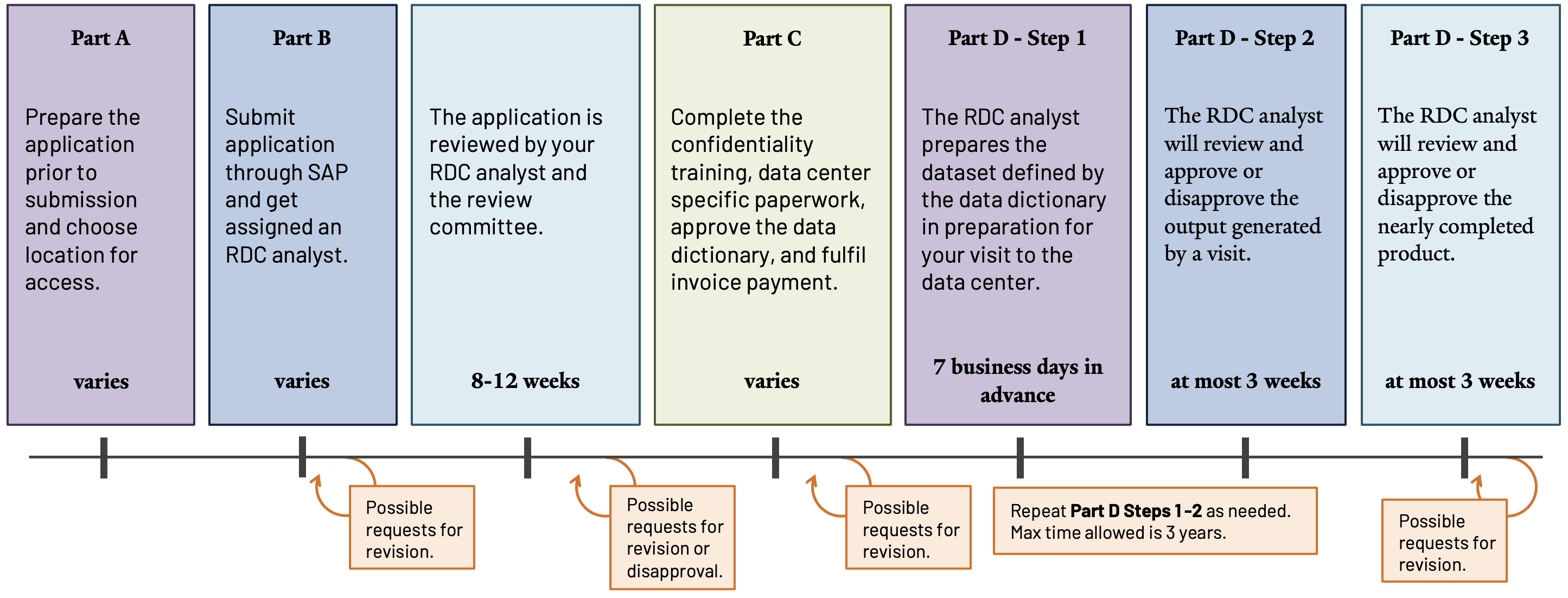
Upon receiving applications, assigned RDC analysts and the review committee—comprised of data system representatives and the confidentiality officer—assess applications for approval, disapproval, or revision requests. If denied, researchers receive justification for the decision and may request appeals through SAP 14.
Studies may require amendments to approved applications. Amendment approvals typically take up to four weeks, but complicated requests may require eight to twelve weeks.
Step-by-Step Guide
a. Prepare Your Application Before Completing the Form
The RDG portal provides access to applications for data from 13 agencies and 3 units within the Federal Statistical System (FSS), including NCHS. Each agency may have additional application requirements. While the RDG User Guide and RDC Application Process page contain detailed information, researchers are encouraged to contact relevant agencies before submitting applications 10,12.
Example applications, data dictionaries, and complete details are available on the RDC Application Process page 10. This summary provides an outline and directs researchers to relevant information sources. Contact the RDC at rdca@cdc.gov for further assistance 12.
Confirm the study requires restricted data access and that FSS data will meet research needs. Contact all relevant agencies or units to verify that required data can be combined, whether restricted-use, publicly available, or non-FSS.
Select a preferred access location and confirm eligibility. Non-U.S. citizens should contact the intended facility before writing proposals to confirm eligibility for data access. Refer to the Data Distribution Centers section for more details.
Data access methods and locations may vary, especially if the data comes from different agencies or units within the FSS.
- The NCHS requires additional documents as *.pdf or *.docx and additional concerns to be addressed beyond the base SAP application. Before starting the application, it is recommended to prepare the following:
A data dictionary listing all requested variables from publicly available, restricted-use, and non-NCHS data sources, which can largely be created using SAP. Refer to the Providing the Public Use and Non-NCHS Data page for additional guidelines on preparing applications with these data types 15.
A description of the research methodology and a list of supporting references.
A detailed description of the intended data product (e.g., paper, journal article, or presentation).
A timeline for managing the project within a three-year period.
An explanation of how the project will benefit NCHS or other data-providing agencies for the Agency Benefits section of the application.
b. Complete the SAP Application Form
- In SAP, search for and select the datasets needed for the study and add them to the checkout basket. Any data added to the same basket will be included in a single application.
Additional data can be added to the application if needed after submission.
When ready to proceed, open the basket and select Start Application. It is recommended that the principal investigator (PI) or co-principal investigator (co-PI) create the application, as only they will be able to make edits after submission.
In the application, the researcher will need to provide their information, a description of the project that demonstrates the need for restricted-use data, and upload the required documents as *.pdf or *.docx. The SAP application and some agency- or unit-specific requirements can be found in the RDG User Guide 12.
Submit the application for review.
c. Review the Committee’s Decision and Finalize the Application
Upon receiving the application, the RDC director will assign the group an RDC analyst who will work with them throughout the entire process of applying for data, accessing the data, and finalizing the output of their results 13. The RDC analyst will:
- Facilitate application review and accept NCHS-required confidentiality paperwork.
- Accept payments incurred by data center access.
- Create datasets by compiling data specified in data dictionaries and linking using designated variables. Analytical datasets are provided during data center visits.
- Review results for disclosure risk and provide them once analysis is completed at data centers.
Researchers with approved applications must complete the following steps to prepare for data access and utilization.
Discuss the committee’s approval with the assigned RDC analyst and address any revision requests as needed.
Provide the RDC analyst with approved data dictionaries, public-use and non-NCHS data, descriptions of desired data linkages with intended final formats, and clearly defined derived variables, including arithmetic code or algorithms.
Complete the Confidentiality and Disclosure training and forms, then provide them to the RDC analyst. Additional forms, documents, and tools are available on the RDC Reference Materials page 16,17.
When invoiced, pay fees incurred by the request and applicable to data access at the intended location and frequency. Complete details are in Fees and Invoicing 18.
Amendments for project changes are possible but require additional approval prior to implementation. Common reasons for an amendment include, but are not limited to, changes in the research team, requests for additional variables, new methods, or requests for additional types of output 10. However, if the scope or research question changes, a new application is required instead.
Contact the RDC directly at rdca@cdc.gov for further guidance.
d. Accessing the Data and Publication Expectations
- After completing the steps in Part C, the RDC analyst will prepare the dataset. Once it is ready, schedule an appointment to access the data at the chosen RDC location. Schedule appointments at least one week in advance.
Different data centers have different access procedures and may incur additional fees depending on frequency of data access. Refer to the Data Distribution Centers section and associated links for additional guidance.
- Upon completion of analysis, submit an output request to the RDC analyst for review and approval. Full details about requirements and expectations are on the Output Policies and Procedures page 19.
NCHS does not guarantee that study-generated output will be released due to concerns related to, but not limited to, privacy and alignment with the approved application.
- When output is nearly complete, send it to the RDC analyst for review before submitting for publication or distribution. Full details about requirements and expectations are on the Publishing Guidelines page 20.
Data Distribution Centers
NCHS data is available at two types of data centers: the Census Bureau’s Federal Statistical Research Data Centers (FSRDC) and the NCHS Research Data Centers (RDCs). Additional details about preparing to access data at one of these sites can be found on the RDC Location of Access page or their respective subpages: FSRDC and NCHS RDC 10,21–23.
Submit an electronic copy of any notes or reference materials needed to the RDC analyst prior to visiting a center. Hard copies of these materials are not allowed. Electronic communication devices, such as phones, pagers, and laptops, are also not permitted in the RDC.
Different software products or add-ons can be requested, though not all requests will be approved. Be aware that requesting additional software accommodations may delay project approval. Contact the specific RDC where data will be accessed for further guidance.
Federal Statistical Research Data Centers
Researchers must be affiliated with a university or agency to qualify for FSRDC access. They must also meet physical and information security requirements, including obtaining Census Bureau Special Sworn Status (SSS) and passing a background investigation. Non-U.S. citizens are generally encouraged to use FSRDCs.
Researchers are assigned both an NCHS RDC analyst and an FSRDC administrator from the location they intend to visit. The NCHS RDC analyst roles were described previously under Part C of the Step-by-Step Guide. The FSRDC (Census RDC) administrator will:
- Be available to answer questions pertaining to SSS, access and entry to a FSRDC location, software availability, and additional Census fees.
- They may be available to help develop the application.
- Transfer output to the NCHS after researchers complete their analysis at a data center. The RDC analyst will review the output for disclosure risk and provide researchers with the results.
If accessing an FSRDC, the data must be transferred from NCHS after completing all requirements outlined by the assigned RDC analyst seven days prior to the intended visit. These additional steps incur extra costs beyond the NCHS RDC data access fee and may delay data access.
- In-person: Census Bureau facilities at partner institutions.
- Remote access: A secure Virtual Desktop Interface (VDI) may be available.
- Software Available: Anaconda, Gurobi, Intel Composer, Knittro, MADD, Mathematica, NATLAB, OpenGeoda, R and Rstudio, SAS, Stat/Transfer, Stata, Stata-MP, SUDAAN, and Tomlab.
NCHS Research Data Centers
- In-person: Facilities located in Hyattsville, MD, Atlanta, GA, and Rockville, MD require appointments scheduled at least one week in advance.
- Remote access: Not available due to computers being disconnected from the internet.
- Software Available: Microsoft Office products, R, SAS, Stata, Python, SPSS (v. 19), and SAS-callable SUDAAN.
Required Documentation
When accessing the data, researchers must provide the following documentation in addition to an approved application:
- Proof of identification, such as a REAL ID
- Curriculum vitae (CV) for each applicant
- For student projects, an agreement form completed by the student’s advisor 24
- Permission to use proprietary data
- Table shells for requested output
- Data dictionary listing all necessary variables (restricted-use, public-use, and external) for the research project (refer to agency dataset data dictionaries for available variables)
Relevant Links
NHIS Questionnaires, Datasets, and Documentation: Find links to all installments or ancillary studies and their associated program methods and documentation 9.
NHIS Restricted Data: Find links to all installments classified as restricted data and their associated program methods and documentation 25.
NCHS Data User Agreement: Find the data use limitations and expectations set by NCHS for using their publicly available data 26.
Confidentiality and Disclosure: Find study participant confidentiality training, documentation, forms, and manual 17. These trainings and forms must be completed following approval of the study proposal by the research committee.
Application Process: Find the complete step-by-step guide for applying for restricted-use data from the RDC 10. Key information is summarized under the Gaining Access - Restricted Access tab.
RDC Reference Materials: Find restricted-use data proposals, example applications, confidentiality and disclosure documents, rules, policies, and data protection toolkits 16.
NHIS Results and Publications: Find reports and publications using NHIS data, statistics accessible in interactive data query systems and Morbidity and Mortality Weekly Report (MMWR) QuickStats, as well as archived reports 27.
Publications
This section presents a selection of PubMed articles that utilize the dataset and are authored by individuals affiliated with the Yale University. These articles are provided to inspire researchers and students to use the data in their own work.
-
Factors Associated With Long COVID: Insights From Two Nationwide Surveys.
Yixuan Wu, Mitsuaki Sawano, Yilun Wu, Rishi M Shah, Pamela Bishop, Akiko Iwasaki, Harlan M Krumholz
The American journal of medicine 2024 Mar 14 doi: 10.1016/j.amjmed.2024.02.032
PMID: 38490304 -
Novel microsimulation model of tobacco use behaviours and outcomes: calibration and validation in a US population.
Krishna P Reddy, Alexander J B Bulteel, Douglas E Levy, Pamela Torola, Emily P Hyle, Taige Hou, Benjamin Osher, Liyang Yu, Fatma M Shebl, A David Paltiel, Kenneth A Freedberg, Milton C Weinstein, Nancy A Rigotti, Rochelle P Walensky
BMJ open 2020 May 12 doi: 10.1136/bmjopen-2019-032579
PMID: 32404384 -
Prevalence of self-reported cancer based on sexual orientation in the United States: a comparative analysis between lesbian, bisexual, gay, and heterosexual individuals.
Samuel Tundealao, Anusha Sajja, Tolulope Titiloye, Iman Egab, Iyanuoluwa Odole
Cancer causes & control : CCC 2023 Jul 12 doi: 10.1007/s10552-023-01749-0
PMID: 37436538 -
Prescribed opioid use is associated with increased all-purpose emergency department visits and hospitalizations in community-dwelling older adults in the United States.
Song Ge, Chong Tian, Liang Wu, Minhui Liu, Haidong Lu
Frontiers in psychiatry 2022 Dec 13 doi: 10.3389/fpsyt.2022.1092199
PMID: 36582257